
Machine Learning? Big Language Model? What A.I. is and is not
It's not intelligent but it can be useful

My hubby is a UNIX system admin who played around with computers in the late 90s. He was in college around that time, and PCs were fast becoming household items (the first person to make jokes about the invention of fire gets elbow-dropped!)
In any case, Mike was building computers from the ground up, developing code, and even designing apps well before there were official terms for such things.
Fast forward to the 2020s, and the world now has AI.
As a graphic illustrator and animator, I wondered if this newfangled software would negatively impact my work and asked hubby about it. Long story short—nope.
He pointed me toward Midjourney, and man; I love it.
Since then, I have incorporated other apps, like Leonardo AI, into my graphics pipeline. As a result, my design routine has become faster and more streamlined.
When I began learning AI, I was greatly surprised by what it does and doesn’t do, especially after all the hype—Dude, I was even afraid to touch it initially. I feared AI offered tailor-made, ready-to-order work with one click and would put me out of business.
Surprise, surprise! It takes hours of prompt engineering to get what you want if you want a solid image. And it still might only be somewhat close to what you envision.
Previous graphic illustration experience helped—a lot
You don’t need previous graphic illustration cred to utilize AI for art and design, but it helps, especially if you want the work to be original and not cross copyright lines. Graphic illustration know-how also assists with any post-work that might need to be done in Adobe CS.
What is AI anyway?
A.I. is a machine learning based on Big Language Modeling. There is no sentience behind AI actions or creations. I think it is more apt to call it “Automatic” Integration.
According to the hubster, who gets this stuff far more than I do, Big Language Modeling takes spoon-fed internet data and quickly compiles information after a user makes a prompt request.
For instance, I might type:
Two women, 18th century biracial woman in a green ball gown with blond hair, kissing beautiful woman with red hair in white gown, 18th - century bedroom, canopy bed, dark mystical fantasy, rococo era, perfect fingers, nice hands, perfect hands, stunning realistic photograph, intricately detailed, cinematic, trending on artstation, hyperrealistic, awesome full color, dark, 12k, high definition, cinematic, stylized digital art, smooth, ultra high definition, 8k, unreal
and get this:
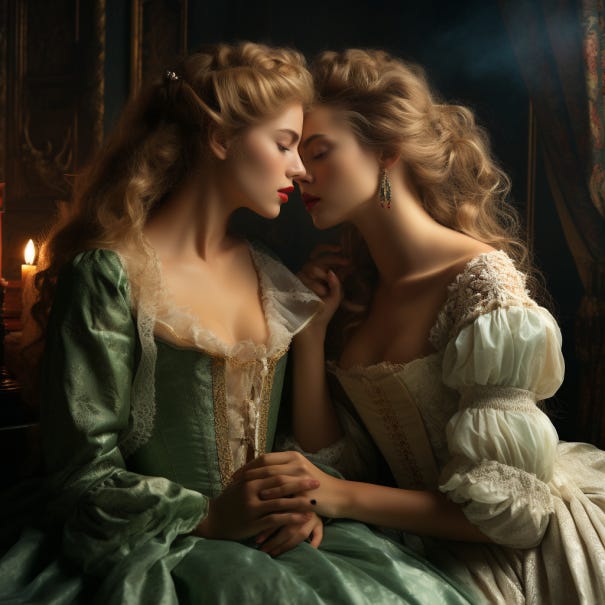
Look at the hands here—not exactly true to life even after I typed “perfect hands.”
If starting from scratch without a base image, you may have to do a ton of postwork to make any image look decent. This is because:
Extremities and limbs almost always look wonky—your characters could have six fingers, three arms, or seven toes.
There is no character consistency or the ability to create custom characters with similar attributes from render-to-render. You get close, but little details will always be off.
Emotional range? Forget about it. You must play with the image to make your people emote realistically. This is where digital painting might come in.
AI doesn’t always know what you are asking and will create some weird stuff. Fonts may not work, and words can be jumbled.
Getting two people in a picture with distinct features is nearly impossible. There is a tendency to mix and match character attributes, likely because the AI is confused about what you are asking.
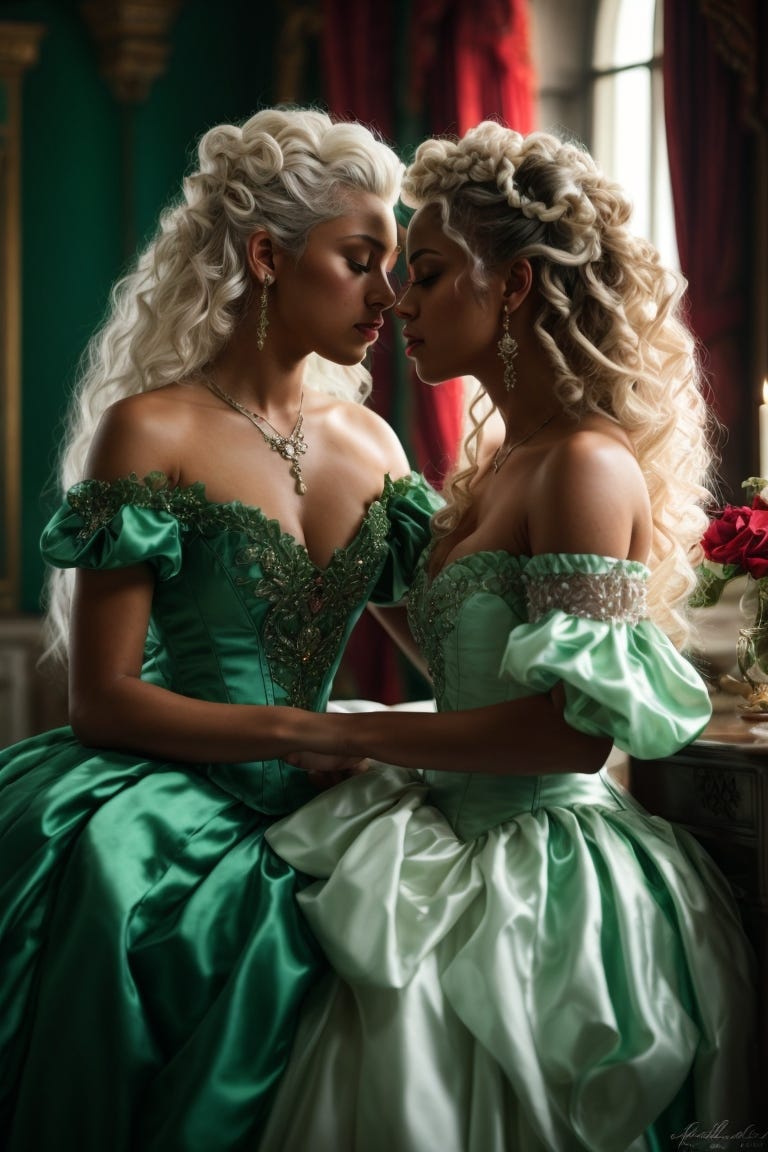
There are no fixes for these things yet, so understanding prompt engineering is essential for coming close enough to what you envision before any post-work.
Thankfully, because I was already familiar with design principles, I use my own illustrations as a baseline to customize AI images.
Regulating AI is a necessity
AI needs to be regulated to offset future abuses because, like any new tech, it will be used for evil by evil folks. Guarantee it. Let us learn from past mistakes and get that jumpstarted now, shall we?
As with any tool, there are pros and cons—play our cards right, AI will be more of an asset to humanity than a hindrance, just like the computer itself.
In future posts, I plan to show you guys a few behind-the-curtain graphic illustration processes via video. Watch this space.
One Love - Alicia